Last updated October 15, 2026
DIY vs Professional ADU: The Riverside Homeowner’s Decision Guide
Here’s a fact most DIY ADU guides won’t tell you: under California’s owner-builder exemption, you can legally act as your own general contractor on an accessory dwelling unit in Riverside, and you’ll sign a form at the city counter that makes you personally liable for every workplace injury on that job site. If your brother-in-law falls off a ladder while helping you frame, his medical claim lands on your homeowners insurance, your assets, and your future. And when you go to sell, you’ll disclose that owner-builder status to buyers, which some lenders treat like a scarlet letter. This guide walks through exactly what you can save doing yourself, what will cost you double when it fails inspection, and where the prefab brands fit into Riverside’s actual permitting reality.
Quick Answer
For most Riverside homeowners, the smart split is hybrid: handle demo, insulation, finish carpentry, and landscape restoration yourself if you have the skills, but hire a licensed contractor for the foundation, electrical sub-panel, and fire-rated wall assemblies that must pass inspection (see our How to Hire a ADU Contractor in Riverside: A Step-by-Step Guide). Pure DIY on a full ADU saves roughly $40,000 to $90,000 on paper, but a failed Riverside inspection, an owner-builder liability claim, or a year-long construction delay wipes out most of that margin. The honest answer: you can legally do more than you think, and you should personally do far less than the internet suggests.
Table of Contents
- What California’s Owner-Builder Permit Actually Allows and Requires
- Where DIY Genuinely Saves Money in Riverside
- Where DIY Almost Always Costs More in the End
- The Prefab ADU DIY Myth: How Boxabl, Tuff Shed, and Abodu Actually Work in Riverside
- Side-by-Side: DIY Budget vs. Professional Written-Price Quote
- Riverside Permits, Inspections, and the Timeline Nobody Budgets For
- The Hidden Risks: Liability, Title Defects, and Resale Complications
- Common Mistakes to Avoid
- When to Call a Professional
- Frequently Asked Questions
- The Bottom Line
What California’s Owner-Builder Permit Actually Allows and Requires
California’s owner-builder exemption lets a homeowner pull a building permit for an ADU on their own primary residence without holding a contractor’s license. The state wrote this into law because it’s your property and the legislature respects that. But the exemption carries strings that most YouTube tutorials conveniently skip, and in Riverside those strings pull tight fast.
When you sign as owner-builder at the Riverside building counter, you sign a disclosure form acknowledging three things in plain language. First, you are personally responsible for worker safety on the site. Second, you are responsible for verifying that every subcontractor you hire carries their own workers’ compensation insurance. Third, you cannot sell the property within one year of final inspection without disclosing your owner-builder status to the buyer and providing a list of every subcontractor you used.
That disclosure isn’t paperwork theater. Here’s what it means in practice:
- Personal liability: If a subcontractor you hire is uninsured and gets hurt on your ADU site, their injury claim goes through your homeowners insurance first, then your personal assets. A licensed contractor carries workers’ comp that shields you from this entirely.
- The one-year sale restriction: Build an ADU as owner-builder, get final sign-off, then try to sell seven months later, and you’ll hand the buyer a disclosure that makes some lenders pause. You’ll also owe a list of every trade that touched the project. Lose that list, and you’ve created a title headache that a real estate attorney may need to unwind.
- Verification duty: The state expects you, not the city, to verify every sub’s insurance and license status. Skip that step, and the exposure is yours alone.
For a homeowner who works in construction or has deep trade contacts, the owner-builder route is workable and can save real money. For the other 95 percent of Riverside homeowners, it converts a manageable project into a second job with legal exposure.
Where DIY Genuinely Saves Money in Riverside
Not everything in an ADU build is high-risk. Several phases of the project are low-liability, low-inspection-stakes work where a competent Riverside homeowner can keep thousands in their pocket without touching the parts of the build that keep inspectors up at night, as covered in our ADU Builders Maintenance Checklist for Riverside Homeowners.
These four areas are where we’ve seen owner-involvement work well:
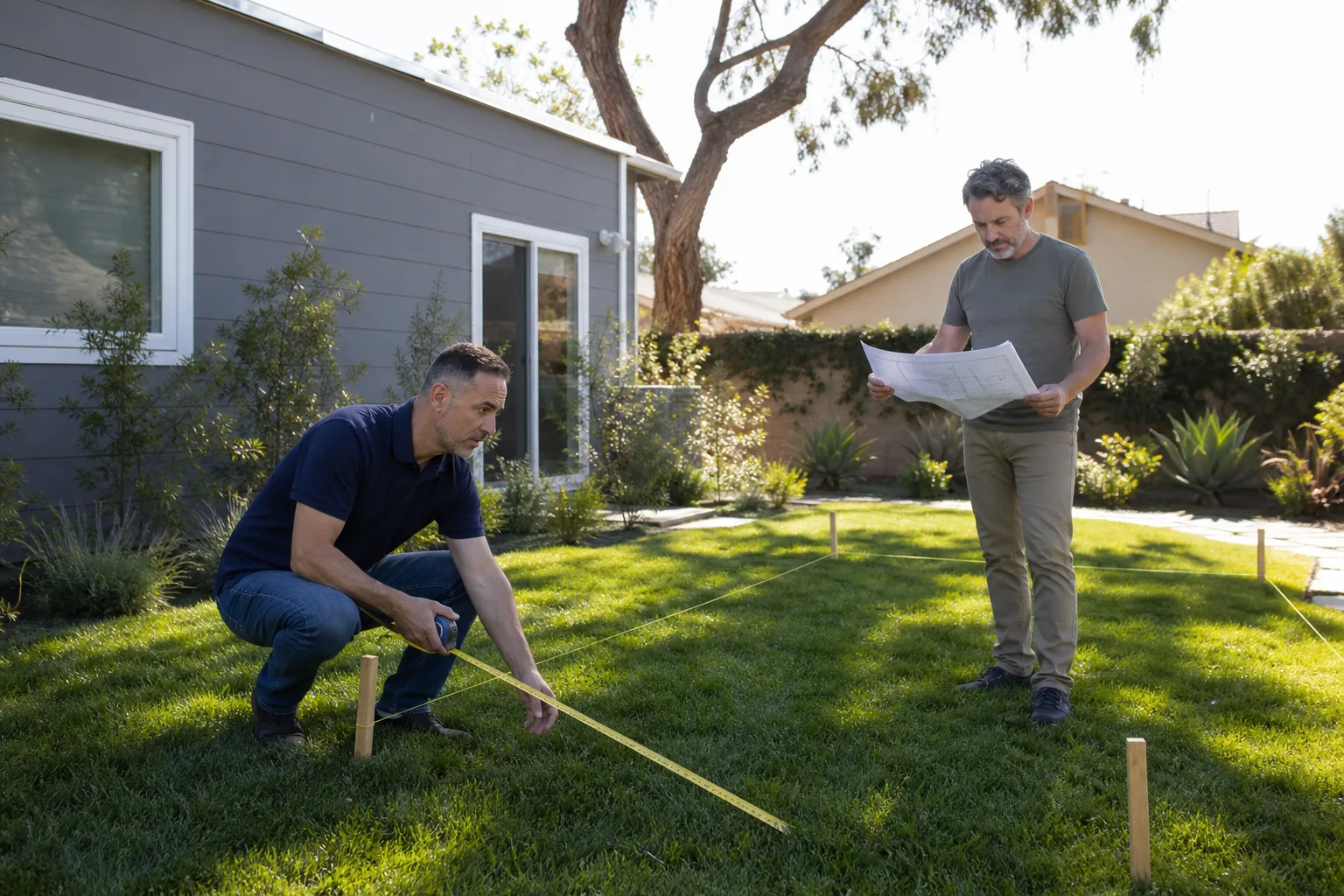
- Demolition and site prep: If you’re converting a garage or tearing out an old shed pad, the grunt work of loading debris and hauling it to the Riverside County landfill is genuinely DIY-able. Just confirm your debris plan with the city before you start, because Riverside has rules about construction waste that catch first-timers.
- Insulation installation: Batting fiberglass into framed walls is repetitive, low-skill work that passes inspection easily when done to the manufacturer’s spec. The materials cost the same whether you or a paid crew installs them, so your labor savings here are real.
- Finish carpentry and trim: Baseboards, door casing, window trim, and closet shelving are cosmetic and minimally inspected. A homeowner with a miter saw, patience, and a few YouTube refreshers can knock out the finish phase over a couple weekends.
- Landscape restoration: After the construction crew leaves, the yard around the ADU looks like a battlefield. Regrading, re-sodding, mulching, and planting are unpermitted work in most Riverside cases, and doing it yourself can save $5,000 to $15,000 depending on yard size.
These phases share a pattern: they’re low-rung work with no sealed engineering behind them and minimal inspection scrutiny. If you’re going to do anything yourself, do these.
Where DIY Almost Always Costs More in the End
Now the other side. Certain phases of an ADU build in Riverside are technical enough that a failed inspection means tearing out work, redoing it, and paying a contractor anyway, plus a delay that pushes your finish date out months. The “savings” go negative fast.
Three phases stand out:
- Electrical sub-panel work: An ADU needs its own sub-panel, and that panel must meet current load calculations, grounding requirements, and arc-fault breaker rules. Riverside inspectors know exactly what they’re looking at. Wire it wrong, and you’ll fail inspection, and a licensed electrician will charge more to fix amateur work than to install it fresh the first time.
- Engineered foundation systems: Riverside’s soil varies by neighborhood, and a slab or pier foundation on expansive or poorly compacted soil needs an engineer’s stamp and specific rebar schedules. Pour it wrong and you’re jackhammering out a failed foundation, which is a five-figure correction and a weeks-long delay. This is not a learning project.
- Fire-rated wall assemblies: California building code requires fire-rated construction on walls facing property lines, and Riverside enforces this aggressively. The assembly details involve specific gypsum layering, fastening schedules, and edge treatments that inspectors check with a level of care that surprises first-timers. Miss a detail, and you’re pulling drywall off to add a layer.
One more phase deserves an honorable mention: anything involving structural headers or shear walls. An ADU’s shear wall holds the building up in an earthquake, and Riverside sits in serious seismic territory. If you get this wrong, the building passes inspection until it doesn’t, and the failure is catastrophic rather than cosmetic.
The Prefab ADU Myth: How Boxabl, Tuff Shed, and Abodu Actually Work in Riverside
Prefab manufacturers market their ADUs as a fast, clean alternative to traditional construction, and the product quality from brands like Abodu and Boxabl is genuinely strong. But there’s a narrative floating around that a prefab ADU is a DIY project because the structure arrives mostly assembled. That’s a dangerous misreading of how Riverside’s permitting and inspection system treats these units.
Here’s what actually happens when you buy a prefab ADU in Riverside:
- The unit arrives on a truck, but it still needs a foundation. That foundation requires the same engineered plans, the same soil report, and the same permit drawings as a site-built ADU. No foundation, no permit.
- Utility connections need licensed trades. The sewer line, water supply, and electrical feed from your main panel to the prefab unit are inspected work. So is the sub-panel. Tuff Shed markets some of its larger structures as ADU-convertible, but the conversion from “shed” to “dwelling unit” triggers the full ADU permit path in Riverside, including the electrical and plumbing.
- The manufacturer’s installation crew is not your GC. A prefab company might set the module on your foundation. That same company does not pull your Riverside permits, coordinate your inspections, or take liability for the site work. You’re either the owner-builder or you’ve hired a GC.
None of this makes prefab a bad option. It makes prefab a good option that still requires professional coordination. In our experience, the homeowners who save the most with prefab are the ones who understand that the factory savings happen in framing and finishes, not in foundations, utilities, and permits. You can still capture those factory savings without taking on owner-builder liability by hiring a contractor who works with prefab brands like Abodu, and who puts the full scope in writing before the unit ever ships.
Side-by-Side: DIY Budget vs. Professional Written-Price Quote
Let’s put numbers on the decision. Here’s a realistic side-by-side for a 500-square-foot, one-bedroom ADU in Riverside, comparing a full owner-builder DIY approach against a professionally built ADU with a written-price quote. These numbers reflect typical ranges for the Riverside market as of 2026.
Owner-Builder DIY Budget (500 sq ft ADU)
- Architectural and engineering drawings: $6,000 to $12,000 (you pay a drafter and engineer directly)
- Riverside permit fees and school/impact fees: $18,000 to $30,000 (yes, Riverside’s ADU fees run that high; confirm current fee schedules at the counter)
- Materials: $70,000 to $110,000 (framing lumber, windows, roofing, drywall, flooring, fixtures, paint)
- Subcontracted trades you must hire out: $25,000 to $45,000 (electrical, plumbing, HVAC, foundation concrete)
- Tool rentals and equipment: $3,000 to $6,000 (excavator, dumpster, scaffolding, air compressor)
- Total DIY budget: $122,000 to $203,000
Plus your time: an experienced DIYer will spend 12 to 18 months on evenings and weekends. An inexperienced one will spend two years or never finish.
Professional Written-Price Quote (500 sq ft ADU)
- Design, engineering, and permit fees: $28,000 to $45,000 (rolled into the contract, managed by the contractor)
- Construction cost, all trades included: $105,000 to $165,000 (this is the full build: foundation through final paint)
- Contingency and project management: $10,000 to $18,000 (written into a fixed quote, so it does not change mid-build)
- Total professional budget: $143,000 to $228,000
The headline gap is $20,000 to $25,000 in the mid-range. But stack the hidden DIY costs against that gap: one failed inspection correction at $4,000 to $8,000, three to six months of lost rental income at $1,800 to $2,400 per month in Riverside, a workers’ comp claim on your homeowners insurance, and the reduced buyer pool when you sell within a year of building. The gap shrinks to nothing, or tips negative, in most scenarios. The trades you’re forced to hire out as a DIYer are the same trades whose profit margin a contractor balances across the whole job. You don’t escape those costs. You just carry them without a license and without warranty coverage.
For a full look at what a professional build actually includes in Riverside, see our guide on ADU Builders in Riverside. If you’re weighing a broader addition instead, the Home Addition Contractor in Riverside page covers that scope. And for a smaller attached room, Room Addition Contractor in Riverside walks through that option.
Riverside Permits, Inspections, and the Timeline Nobody Budgets For
Riverside’s ADU permitting process moves faster today than it did in 2019, thanks to state mandates that forced cities to streamline accessory dwelling unit approvals, though Seasonal ADU Care for Riverside: Year-Round Homeowner’s Guide explains why timing still matters. But “faster” still means four to eight months from application to issued permit on a typical project, and every inspection phase adds calendar time.
Here’s the inspection sequence on a typical Riverside ADU, and why each one matters:
- Foundation inspection: Before concrete is poured, an inspector verifies rebar placement, depth, and form dimensions against the engineered plans. Fail this, and you’re cutting out rebar and resetting forms before you can pour.
- Rough framing and shear wall inspection: The inspector checks structural components, fire-rated assemblies, and the nailing schedule on shear walls. This is the most common failure point for DIY builders.
- Rough electrical, plumbing, and mechanical inspection: All systems are checked in-wall before drywall closes them up. Failures here mean opening walls back up, and drywall work is expensive to redo.
- Insulation inspection: Verifies R-values and proper installation before drywall. Simple to pass if installed correctly.
- Final inspection: Covers everything from outlet polarity to exit requirements to smoke detectors. A final inspection fail can be as minor as a missing CO detector or as major as an unpermitted modification.
Each failed inspection adds one to three weeks to your timeline while you correct the issue, re-schedule, and wait for the inspector’s next available slot. A contractor who builds ADUs in Riverside every month knows what each inspector looks for and designs the work to pass the first time. A DIYer learns what the inspector looks for by failing.
The Hidden Risks: Liability, Title Defects, and Resale Complications
The DIY-versus-professional ADU conversation usually frames the decision around cost per square foot. That’s the wrong frame. In Riverside, the decision is really about risk exposure, because an ADU that fails inspection, or gets built without permits entirely, creates a legal and financial problem that attaches to the property itself.
Here’s what that looks like:
- Title defects: If you build an unpermitted ADU and then sell the house, the buyer’s lender will flag the unpermitted square footage during appraisal. The deal collapses, or you’re forced to either legalize the unit (which can mean opening walls to expose unpermitted work) or tear it out. Either way, the sale is dead until it’s resolved.
- Insurance gaps: If your unpermitted ADU causes a fire or flood, your insurer can deny the claim because the structure wasn’t permitted. You’re out the structure and the liability.
- Owner-builder disclosure: Even a fully permitted, fully inspected owner-builder ADU requires disclosure when you sell within a year, and many buyers’ agents treat that disclosure as a negotiation anchor that drops your price.
- Contractor-induced defects: This one cuts both ways. A bad contractor can produce the same title defects as a bad DIY job. The difference is that a licensed contractor carries insurance and a bond that covers correction costs, and under California law you have recourse through the Contractors State License Board. As your own contractor, you carry that exposure personally.
The financially literate way to think about this: a professional ADU build costs more upfront and transfers most of the tail risk to a licensed, insured party. A DIY build costs less upfront and transfers that tail risk to you. Riverside real estate is expensive enough that a five-figure title correction is a rounding error against the home’s value, but it’s also the kind of rounding error that kills a sale at the worst possible moment.
Common Mistakes to Avoid
- Pulling an owner-builder permit without reading the disclosure form you’re signing. That form isn’t boilerplate. It assigns liability and restricts your sale timeline, and it’s legally binding the moment your pen leaves the paper.
- Hiring unlicensed subcontractors to save money on the trades you can’t do yourself. When their work fails, you own it. When they get hurt, you own that too. Riverside inspections don’t check a subcontractor’s license; that’s on you.
- Building first and asking for forgiveness later. Riverside’s code enforcement catches unpermitted ADUs regularly, often triggered by a neighbor complaint or a property tax reassessment. The correction is always more expensive than the permit would have been.
- Underestimating the timeline by 100 percent. If you think your DIY ADU takes six months, budget for a year. If you think a year, budget for two. Every phase runs long when you’re learning it as you go.
- Assuming prefab means permit-free. Prefab ADUs from Abodu, Boxabl, and similar brands are factory-built structures, not permit exemptions. The foundation, utilities, and site work all go through the same Riverside process.
- Skipping the written contract on subcontracted work. A verbal deal with a concrete guy goes bad exactly as often as you’d expect, and without a written scope and price, you have no recourse. This is the single most avoidable DIY mistake we see.
- Underinsuring the project during construction. Your standard homeowners policy doesn’t cover a half-built ADU, a subcontractor injury, or theft of building materials unless you add coverage. Confirm with your agent before demo day.
When to Call a Professional
Call a professional the moment any of these descriptions applies to you: you don’t have 15 to 25 hours a week to spend on the project for the next year, you can’t read a foundation plan, you’ve never pulled a permit in Riverside, or you simply don’t want your name on the legal liability that California’s owner-builder form assigns. There’s no shame in any of those. A Benson ADU Riverside home consultation starts with a written price and a clear scope, so you know the professional route’s real cost before you commit either way. If you’re on the fence, get the quote and compare it honestly against your DIY budget. Benson ADU Riverside offers free estimates in Riverside, call (831) 231-0809.
Frequently Asked Questions
A 500-square-foot ADU in Riverside typically costs $143,000 to $228,000 when professionally built with a written-price quote, and $122,000 to $203,000 as an owner-builder DIY project before hidden costs like failed inspections and lost rental income are factored in. A garage conversion runs 20 to 30 percent lower, while a two-bedroom unit can push past $300,000. Call (831) 231-0809 for an exact line-item quote on your specific lot, our estimates are free and written.
Yes, California’s owner-builder exemption lets you pull an ADU permit on your own primary residence without holding a contractor’s license, provided you live in the home and sign the owner-builder disclosure form at the Riverside building counter. That form makes you personally liable for worker injuries and requires you to disclose owner-builder status if you sell within one year of final inspection. If that tradeoff doesn’t sit right, call (831) 231-0809, and we’ll walk you through the professional route.
Not with a written-price contract, which locks the line items and totals before any work begins, and that’s the standard we hold ourselves to on every Riverside ADU project. The only changes come from change orders you approve in writing, for scope changes you request. A verbal estimate can float; a written contract shouldn’t, and if a contractor won’t put it in writing, that’s your red flag. Call (831) 231-0809 for a written quote you can hold us to.
A professionally built ADU in Riverside typically takes six to ten months from permit application to final inspection, while a DIY owner-builder project usually runs twelve to twenty-four months because the homeowner is learning each phase as they go. Failed inspections add one to three weeks each, and permit approval alone takes four to eight months regardless of who builds it. If you’re planning rental income, factor that delay into your budget. Call (831) 231-0809 for a realistic timeline on your specific project.
No, prefab ADUs from Boxabl, Abodu, Tuff Shed, and similar brands require the same Riverside building permits, foundation engineering, and utility inspections as a site-built ADU. What prefab skips is framing and finish time on site, which can cut construction time by weeks or months, but the permitting and foundation work is identical. If prefab appeals to you, call (831) 231-0809 and we’ll explain which brands make sense in Riverside and what the full permitted cost looks like.
The biggest hidden cost is a failed inspection that forces you to tear out and redo work you’ve already paid for, with electrical sub-panel corrections and fire-rated wall assembly fixes running $4,000 to $8,000 per incident and adding weeks to your timeline. Close behind is the owner-builder liability exposure, where a single uninsured subcontractor injury becomes a personal financial problem. Get a written quote from a licensed contractor before you commit to DIY so you know the real gap. Call (831) 231-0809.
The Bottom Line
The DIY-versus-professional ADU decision in Riverside comes down to one honest question: do you have the time, skill, and risk tolerance to carry a full construction project’s liability on your own signature? The cost gap between the two routes is real but narrow when hidden costs are priced in, and the risk gap is wide in the professional’s favor. Most homeowners do best with the hybrid approach: take the low-risk DIY phases, hand the foundation, electrical, and fire-rated work to a licensed contractor, and get everything in writing before anyone swings a hammer. Whatever you decide, know the owner-builder form you’re signing before you sign it, and explore more guides & resources to keep your project on track.
Written by Troy Eastman, Owner at Benson ADU Riverside, serving Riverside since 2006.