Last updated October 15, 2026
Seasonal ADU Care for Riverside: Year-Round Homeowner’s Guide
Riverside gets about 10 inches of rain a year, but nearly all of it arrives inside a six-week window, hitting soil that has been baked rock-hard since May. That rapid saturation is the leading cause of ADU foundation drainage issues across the Inland Empire, and it is almost entirely preventable with one fall task most homeowners skip. This guide-along with our ADU Builders Maintenance Checklist for Riverside Homeowners-walks through what actually wears down an accessory dwelling unit in Riverside’s specific climate: sun damage that never takes a season off, Santa Ana winds that show up like clockwork, and the kind of rain that turns compacted dirt into moving water. By the end, you will know exactly what to check each season, what it costs to ignore, and when to call a pro.
Quick Answer
Seasonal ADU care in Riverside means preparing for concentrated winter rain on sun-baked soil, managing heat and UV exposure through 300-plus sunny days, and securing the structure against Santa Ana winds from October through January. The single highest-impact task is a fall drainage and seal inspection before the wet window opens, followed by a spring post-rain slab and exterior check.
Table of Contents
- Fall Prep: The Six-Week Window That Protects Your ADU All Year
- Summer Heat Management: What Riverside’s UV Index Actually Does to an ADU
- Santa Ana Wind Season: The Checklist Nobody Hands You
- Spring After the Rain: Slab Checks, Sealing, and Electrical Safety
- Tenant-Occupied vs. Owner-Occupied ADUs: How Maintenance Changes
- What Seasonal ADU Maintenance Costs in Riverside
- Common Mistakes to Avoid
- When to Call a Professional
- Frequently Asked Questions
Fall Prep: The Six-Week Window That Protects Your ADU All Year
Riverside’s rain pattern is deceptive. Ten inches a year sounds manageable until you realize most of it falls between November and January on ground that has not absorbed meaningful moisture since spring. Hard-packed soil acts like a sloped parking lot when the first real storm hits: water sheets off the surface, finds the lowest point, and pools exactly where your ADU’s foundation meets the ground. The fix is not complicated, but it has to happen before the first storm, not after you see water at the slab edge.
Here is the fall prep sequence we put every Riverside ADU through, roughly six to eight weeks before the first rain forecast:
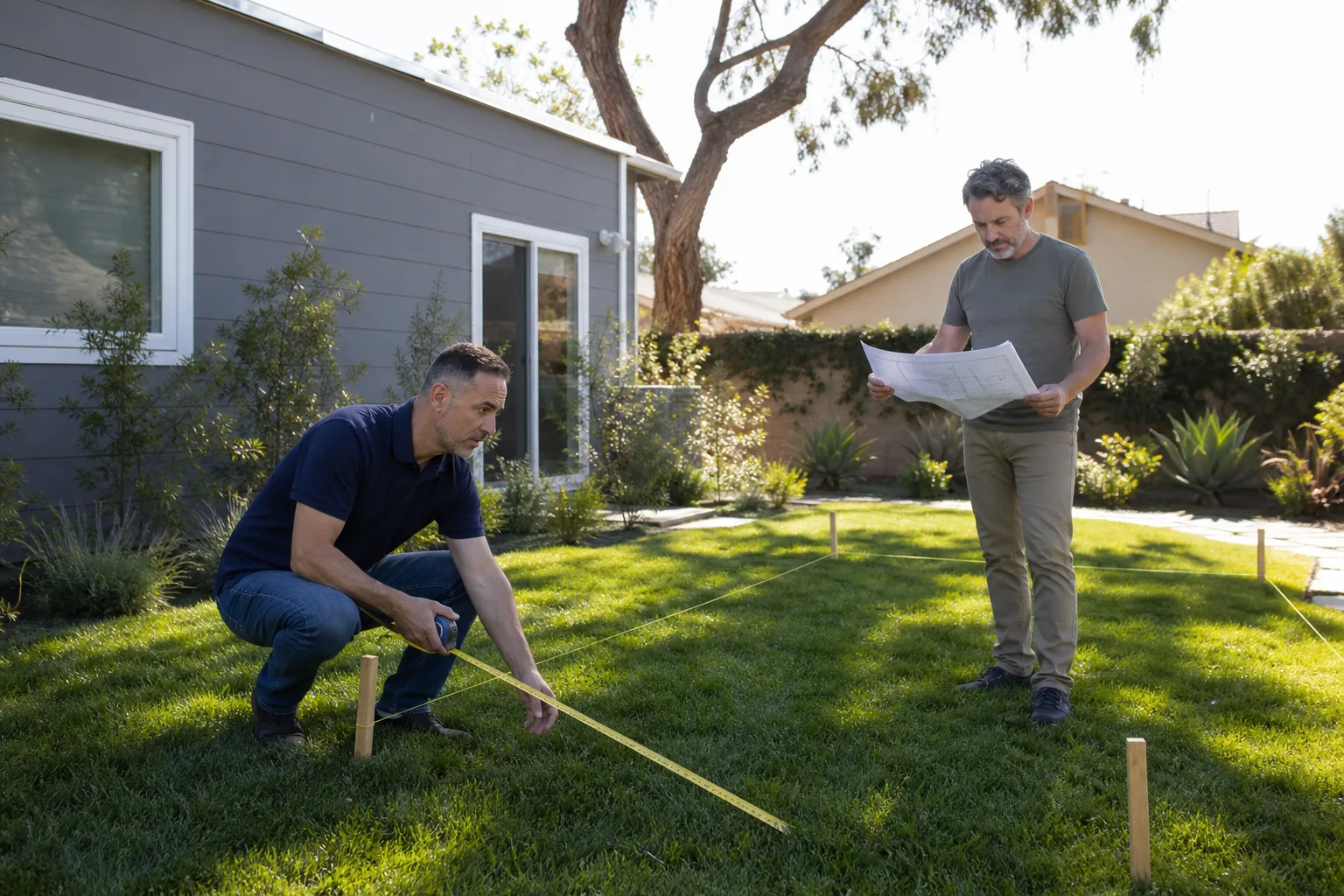
- Walk the grade. Look at the ground slope within four feet of the ADU’s foundation on all sides. Soil should fall away from the structure at a minimum of six inches over the first ten feet. After a dry summer, soil settles, and previously correct grading can drift flat or even slope toward the slab. Pull any mulch, gravel, or decorative rock that has built up against the siding and check the actual dirt line, not the surface dressing.
- Extend the downspouts. A downspout that dumps roof water two feet from the wall is a slow-motion foundation problem. In Riverside’s clay-heavy soils, that concentrated water migrates along the foundation and creates pressure that leads to slab cracks. Add extensions that carry water at least five feet out, and point them toward a landscaped area or drainage swale, never toward the neighboring property line.
- Check window and door seals. Riverside’s dry heat shrinks and cracks caulk and weatherstripping faster than coastal climates do. Run a hand along every window and exterior door frame, especially on south and west exposures, and replace anything brittle, gapped, or peeling. The goal before the wet window is a continuous seal at every penetration.
- Clean the roof and gutters. Even a small ADU with a low-slope roof collects leaves from surrounding trees. Debris dams in gutters send water over the edge in sheets, which is exactly what saturates the soil at the foundation line. Clear gutters, check downspout joints, and inspect the roof surface for any cracked sealant around vents or penetrations.
- Test the GFCI outlets. Riverside’s dry season means the first rain introduces moisture to exterior boxes and any outlet near a window or door. Press the test button on every GFCI outlet in the ADU, including exterior ones. If one does not trip and reset, replace it before wet weather makes a minor fault into a safety issue.
This entire fall pass takes about two hours. Skipping it is how a $40 tube of sealant becomes a $4,000 drainage repair, and in Riverside’s soil, that progression happens over a single season, not years.
Summer Heat Management: What Riverside’s UV Index Actually Does to an ADU
Riverside averages more than 300 sunny days a year, with summer highs routinely in the high 90s and UV indexes that sit in the very high range from May through September. For an ADU, that means the exterior is under continuous attack from heat and ultraviolet radiation, and the cooling system runs harder than any other mechanical component. Seasonal heat care is less about avoiding the heat and more about making sure your ADU sheds it efficiently.
The first thing to understand is that a mini-split heat pump does double duty in Riverside: it is your primary cooling source and, often, your primary heating source in winter. A dirty filter or low refrigerant does not just cost comfort, it costs real money on the electric bill. Every spring, before the heat settles in, clean the indoor unit filter, clear any vegetation or debris from the outdoor condenser, and run the system in cooling mode for 15 minutes while you listen for anything that sounds labored. If the air coming off the indoor unit is not noticeably cooler than the room within 10 minutes, there is an efficiency problem worth checking before a July heatwave, not during one.
Roof systems on Riverside ADUs deserve specific attention. Many are built with low-slope designs, which means they absorb more direct sun per square foot than a pitched roof. If your ADU has a radiant barrier installed under the roof deck, its performance degrades over years of extreme heat cycling; check for tears or sagging in the accessible attic space. For ADUs with cool-roof coatings, the reflective surface wears down faster in Riverside’s UV index than manufacturer averages suggest. A simple observation test: on a sunny afternoon, a cool roof should feel noticeably less hot to the touch than a nearby standard surface. If it does not, the coating has likely lost reflectivity and needs reapplication.
Windows do more heat damage than most people assume in Riverside. West-facing windows turn an ADU into an oven between 3 and 7 p.m. from June through September. Exterior shade screens, properly installed awnings, or solar film cut the heat load before it enters the building envelope, which means the mini-split works less and lasts longer. None of these are structural changes, and all of them pay for themselves quickly in a climate where cooling runs five months out of the year.
We have walked into Riverside ADUs in August where the interior was 88 degrees at noon with the mini-split running full blast. In nearly every case, the problem was not a failed system but a combination of neglected maintenance and unmanaged heat gain. The fix, applied with some attention to detail, was under $500 in every instance, which tells you something about how much small seasonal care matters here.
Santa Ana Wind Season: The Checklist Nobody Hands You
From October through January, Riverside gets Santa Ana wind events: dry, gusty winds that come off the high desert and funnel through the passes and canyons at speeds that regularly hit 40 to 60 miles per hour, with stronger gusts possible. These winds carry dust, debris, and enough force to peel loose flashing, rattle poorly secured panels, and drive fine grit through any gap in the building envelope. A standard four-season maintenance list, written for a generic climate, does not include this, but it is one of the most destructive variables in Riverside specifically.
Here is a practical Santa Ana checklist to run through each September, before the wind season starts:
- Inspect soffit vent screens. Soffit vents keep your attic space breathing, but torn or loose screens are an open invitation for embers and wind-driven debris. Riverside’s Santa Ana conditions are a genuine wildfire risk multiplier in surrounding vegetation. Check every screen for gaps, tears, or missing fasteners, and replace anything compromised. A roll of fine-mesh screen costs under $30, and it is the difference between a ventilated attic and an attic full of leaf litter, dust, or worse.
- Check any fence attachment to the ADU structure. Many Riverside backyards connect a fence line directly to the ADU wall, especially in corner-lot configurations. When a 50-mph gust loads that fence, the force transfers into the structure at the attachment point. If the connection is loose, you get noise, movement, and eventually water intrusion at the penetration. Make sure any bracket or ledger connection is tight, and if the fence moves more than an inch at the ADU end, reinforce it or add a standalone post to break the load path.
- Verify exterior door seals on windward exposures. The west and north sides of an ADU take the brunt of Santa Ana wind. Even a small gap at the bottom of an exterior door pulls a surprising amount of dust through the building over the course of a season. Run the dollar-bill test: close the door on a dollar bill and pull. If it slides out easily, the sweep needs replacement or adjustment.
- Secure any loose exterior items. Ladders, patio furniture, trash bins, and garden supplies become projectiles in Santa Ana conditions. Anything stored against the ADU exterior should be strapped, moved inside, or at minimum positioned so a gust cannot drive it into the siding or windows. A plastic trash bin at 50 mph puts a serious dent in HardiePlank or stucco.
- Check roof flashing and edge trim. Gusty wind finds any lifted edge. Walk the perimeter and look up at the roof line with binoculars if needed. Anything flapping, lifted, or visibly loose should be secured before the first wind event, because the subsequent wind events will only worsen it.
This is a 45-minute check. In our experience, the September pass catches the majority of wind-related ADU issues in Riverside before they become November damage.
Spring After the Rain: Slab Checks, Sealing, and Electrical Safety
Once the wet window closes in Riverside, usually by early to mid-March, the ground shifts back into its dry cycle, and the structure shows you everything the winter did to it. Spring maintenance on an ADU is about inspection first, repair second, because the damage that matters is often subtle: a hairline crack that opened, a seal that failed, an outlet that got damp and never quite dried.
Concrete slab inspection. Walk the entire perimeter of the ADU and inspect the exposed slab edge for any changes from the previous fall. Riverside’s expansive clay soils swell when wet and shrink when dry, and that cycle can lift or drop a slab enough to create hairline cracks at the corners or near windows and doors. Look for cracks wider than 1/8 inch, any vertical offset between slab sections, or doors and windows that suddenly stick or rub. A hairline crack that does not change year over year is usually cosmetic; a crack that appears or widens after a wet winter deserves a professional look before the next dry season turns it into a structural conversation.
Exterior resealing. Whether your ADU is clad in fiber cement like James Hardie or traditional stucco, spring is the right time to check the paint and sealant layer. Riverside’s winter rain followed by spring sun is a harsh expansion and contraction cycle. Look for peeling paint at the bottom two feet of walls, hairline cracks in stucco corners, and any caulk joints that look chalky or pulled away. Re-caulking windows, doors, and utility penetrations in March or April prevents water intrusion during the next winter and reduces the July heat gain through hidden gaps.
GFCI and outdoor electrical testing. Winter moisture and spring irrigation get into outdoor outlets and any exterior fixture. Test every GFCI outlet again in spring, including those that passed in fall. An outlet that trips repeatedly in spring but passed fall testing may have moisture in the junction box. Also check the weatherproof covers on exterior outlets: the gaskets crack and shrink in Riverside’s sun, and a failing cover is a slow water leak into an electrical box.
Drainage recheck. The first post-rain month is when drainage problems declare themselves. Look for any signs of standing water near the foundation after normal rainfall, especially in the corners where the grade meets the slab. If you see water marks on the slab edge, or new erosion gullies in the soil near the foundation, the winter revealed a grading problem that needs correction before next fall. This is often a one-day fix with compacted fill, but it only gets worse if left through a summer of settlement.
If your ADU was built by a quality contractor, spring is also the time to check any covered repair work. A well-built ADU with a proper drainage plan should not need major work after its first winter, but every structure settles, and the first dry season is when you learn what actually needs attention.
Tenant-Occupied vs. Owner-Occupied ADUs: How Maintenance Changes
If your Riverside ADU is a rental, seasonal care requires legal notification planning in a way that an owner-occupied unit does not. California law requires 24-hour written notice before entering a tenant-occupied dwelling for non-emergency maintenance, which means your seasonal inspection schedule has to be built around notice requirements, not just the weather.
The practical difference comes down to scheduling in advance. A fall drainage inspection that an owner might do on a Saturday afternoon becomes a planned visit with a written notice, a stated purpose, and a specific time window. The same applies to spring GFCI testing and summer mini-split cleaning. None of this is burdensome if you build it into a recurring calendar, but it does mean you cannot run over at the first sign of rain and check the downspouts without following the notice rules.
There is also a distinct advantage to tenant-occupied ADUs, and it is worth naming: you have a person on site every day who will tell you when something is off. A tenant notices a door that sticks, a bedroom that stays hot, or water that pools near the back wall. An owner-occupied ADU relies on the owner to be just as observant, and owners are often slower to notice their own unit’s small changes simply because they live in them every day. Build a simple system: a short seasonal checklist for the tenant, with a clear channel to report issues, and you will catch small problems months before they become callouts.
For rental ADUs, we recommend doing major seasonal checks between tenancies when possible. A vacant day between tenants is the easiest, least legally encumbered time to walk the whole unit, get eyes on everything, and schedule any work. Even if that is not always possible, it should be the goal for the big three passes: fall drainage, spring exterior, and the annual mini-split service.
What Seasonal ADU Maintenance Costs in Riverside
Homeowners deserve a ballpark before they call. For deeper numbers, see our ADU Cost Breakdown: The Riverside Homeowner’s Reference for 2026; here is what seasonal ADU care typically runs in Riverside, based on local labor rates and material costs in 2024 and early 2025:
- Gutter cleaning and downspout check on a standard ADU: $120 to $250, depending on roofline height and debris volume.
- Window and door re-caulking for a typical one-bedroom ADU: $200 to $450 for full replacement of failing seals and weatherstripping.
- Downspout extensions and basic grading correction: $150 to $600 for standard installations; a full grading rework exceeds this range and typically runs $1,500 to $4,000.
- Mini-split annual service, including coil cleaning and filter replacement: $150 to $300 per unit, depending on system size and age.
- Soffit vent screen replacement for an entire ADU perimeter: $100 to $300 with materials included.
- Exterior spot repainting and sealant touch-up after winter: $400 to $1,200 for a small ADU, depending on extent.
- Full exterior cool-roof coating reapplication on a low-slope ADU roof: $2,500 to $5,500, depending on roof area and condition.
- GFCI outlet replacement, per outlet: $35 to $90 if it is a straightforward swap; more if wiring needs correction.
These are broad ranges, and your specific ADU will fall somewhere within them based on size, access, and condition. What is consistent across Riverside is this: the cost of scheduled seasonal maintenance is a fraction of the cost of the failure it prevents. A $200 gutter cleaning prevents $4,000 in drainage repair. A $300 mini-split service prevents a $3,500 compressor replacement. The math is not subtle.
Common Mistakes to Avoid
- Treating Riverside’s climate as mild and therefore low-maintenance. This is the most expensive misunderstanding in Inland Empire homeownership. A climate with no snow and little rain still puts serious stress on a structure through UV, heat cycling, and wind. Mild does not mean maintenance-free.
- Waiting until it rains to think about drainage. By the time water is pooling against the slab, the damage is already underway. Drainage work has to happen before the wet window, because compacted Riverside soil absorbs nothing quickly and moves water exactly where you do not want it.
- Skipping the Santa Ana wind check entirely. Most generic seasonal checklists do not even mention wind, which is precisely why so many Riverside ADUs accumulate slow wind damage at soffits, seals, and fence attachments. The wind season is real, and it is predictable.
- Assuming a mini-split that turns on is a mini-split that works well. A system running at 60 percent efficiency still produces cool air. It also doubles your cooling bill and wears out years early. Annual service is not optional in a climate with five months of hard cooling demand.
- Ignoring the first hairline crack in a slab after winter. Small cracks are often cosmetic, but some are the first sign of drainage-driven movement. Noting the crack, monitoring it through one dry season, and getting a professional opinion if it grows costs almost nothing. Ignoring it until a door no longer closes turns a conversation into a project.
- Treating tenant-occupied and owner-occupied ADUs identically. Rental ADUs require 24-hour notice and planned access, which means your maintenance calendar has to account for legal timing, not just weather timing. A landlord who never runs seasonal checks on a rental ADU is the same landlord who gets a 9 p.m. emergency call for a problem that a March inspection would have caught.
When to Call a Professional
Some seasonal care is genuinely DIY, and this guide has leaned that way where it is safe and straightforward. But several conditions warrant a trained set of eyes. Any widening slab crack, sticking door or window that appears after a wet winter, oder pooling water after normal rain deserves a professional drainage assessment. Electrical work beyond swapping a GFCI outlet should be handled by a licensed electrician, not a watch-and-see approach. Roof work on a low-slope ADU, especially anything involving a ladder and heights, is not a DIY hour: falls from even a single-story ADU roof produce life-altering injuries, and professionals have the right equipment and training. When in doubt, a maintenance inspection from a qualified contractor costs less than the repair for a missed problem; our ADU Permits, Codes & Inspections in CA: What You Need to Know explains which inspections are required and when. Benson ADU Riverside offers free estimates in Riverside – call (831) 231-0809 and we will walk the property with you.
Frequently Asked Questions
A complete year of seasonal maintenance for a standard one-bedroom ADU in Riverside typically runs $800 to $1,800, covering a fall gutter and drainage pass, spring exterior and electrical checks, annual mini-split service, and Santa Ana wind prep. Larger ADUs, older units, or those with deferred maintenance can run higher. The cost protects against repairs that routinely run $3,000 to $10,000 when neglected. Call (831) 231-0809 for a free estimate on any maintenance item.
Start fall ADU prep in Riverside by late September or early October, roughly six weeks before the first meaningful rain forecast. That gives you time to complete grading, gutter, seal, and downspout work before the November-through-January wet window, when the work becomes significantly harder and less effective.
Yes, and the schedule needs to be planned around a 24-hour written notice requirement before entering the dwelling. Work the same seasonal passes, but build the calendar in advance, notifying tenants of specific inspection windows. Between-tenancy vacancies are the easiest time for the full seasonal walkthrough.
For a standard one-bedroom ADU in Riverside, a complete seasonal inspection takes 45 minutes to two hours depending on the season and the unit’s age. The fall drainage and seal pass runs longer because it involves gutter, downspout, and grade assessment. Spring passes are often shorter, focused on slab checking, sealant, and electrical testing.
Drainage and soil saturation issues are the most common seasonal ADU failures in Riverside. The combination of hard-baked summer soil and sudden winter rain causes water to pool and migrate against foundations, leading to slab cracks, door misalignment, and seal failures. Fall grading and downspout work prevent nearly all of these.
Most of the inspection and light maintenance in this guide is DIY-appropriate for a comfortable homeowner: gutter cleaning, seal checking, GFCI testing, and visual slab inspection. Leave electrical wiring, roof work at height, and any structural crack assessment to licensed professionals. When in doubt, a free estimate from ADU Builders in Riverside gives you a written price before any work starts.
The Bottom Line

Riverside’s climate does not hit an ADU all at once. It wears it down in cycles: UV and heat for eight months, wind for four, and sudden, concentrated rain for six weeks. The homeowners who protect their investment are the ones who work with those cycles instead of against them. Fall drainage prep, summer heat management, Santa Ana wind checks, and spring post-rain inspection are not optional extras, they are the maintenance rhythm that keeps a Riverside ADU solid, efficient, and dry for decades. Run the checklist, fix what is failing, and when something is beyond your comfort level, get a professional opinion before small becomes structural. For ongoing guidance, explore our more guides & resources.
Written by Troy Eastman, Owner at Benson ADU Riverside, serving Riverside since 2006.