Last updated October 15, 2026
ADU Permits, Codes & Inspections in CA: What You Need to Know
California law says a city must approve or deny an ADU permit within 60 days – but that clock doesn’t start until your application is deemed “complete,” a determination Riverside can take up to 30 additional days to make. Knowing this one gap can reshape your entire project timeline. This guide walks through what the state’s ADU reforms actually changed, what they didn’t, and the specific Riverside permit workflow from application to final inspection. We’ll cover fees, corrections, inspections, and the questions most guides skip entirely.
Quick Answer
ADU permits in California follow state-mandated timelines – 60 days for approval or denial once your application is deemed complete – but local requirements for drawings, fees, and inspections still vary by city. In Riverside, expect a 30-day completeness review, three core inspection milestones (foundation, rough, final), and impact fees that depend on your ADU’s square footage. A compliant application package submitted correctly the first time is the single biggest factor in keeping your project on schedule.
Table of Contents
- What AB 68, SB 9, and AB 2221 Actually Changed (And What They Didn’t)
- Riverside’s Submission Checklist: What You Need at Intake vs. What Can Follow
- The Three Inspection Milestones: What Riverside Inspectors Commonly Flag
- Impact Fees: What California Prohibits vs. What Riverside Can Still Charge
- How to Respond to a Correction Notice Without Losing Your Place in Line
- How Prefab ADUs Change the Permit Conversation
- Common Mistakes to Avoid
- When to Call a Professional
- Frequently Asked Questions
What AB 68, SB 9, and AB 2221 Actually Changed (And What They Didn’t)
Between 2020 and 2023, California passed a wave of ADU legislation that fundamentally rewired how cities can regulate accessory dwelling units. The laws removed many local barriers, but they didn’t create a uniform process. Here’s the plain-English breakdown.
AB 68 (2020) did three big things. First, it forced cities to approve or deny an ADU application within 60 days of deeming it complete – no more open-ended “we’ll get to it” from planning departments. Second, it eliminated minimum lot size requirements for ADUs. Third, it reduced setbacks for ADUs to 4 feet from side and rear property lines, which matters in Riverside neighborhoods where older lots were platted tight against property lines.
SB 9 (2022) is often confused with ADU law, but it’s really about lot splits and duplexes. What matters for ADU owners: SB 9 requires cities to approve a second unit on a single-family lot, which can stack with ADU allowances. On a single Riverside lot, you could potentially have a primary residence, an ADU, a JADU (junior ADU), and an SB 9 unit – though setback, parking, and utility constraints usually dictate what’s practical.
AB 2221 (2023) tightened the screws further. It clarified that cities cannot require replacement parking when a garage is converted to an ADU. It also expanded what counts as an “existing structure” conversion, and it made it harder for cities to reject applications for minor errors. The law says cities should issue a correction list rather than a rejection when items are missing – a distinction we’ll get into later because it affects your queue position.
What these laws didn’t change: building codes themselves. Fire-rated walls, egress windows, ceiling heights, ventilation – all still enforced through California Building Code (CBC) and local amendments. The state laws changed the process, not the physics. A Dvele or Boxabl prefab unit still needs a foundation that meets Riverside soil conditions, even if the wall panels arrive pre-approved.
In practice, what we see in Riverside is a city that’s more cooperative than it was pre-2020, but still requires a complete, legible, code-correct package. The law gives you the right to a 60-day decision. It doesn’t give you the right to a rubber stamp.
Riverside’s Submission Checklist: What You Need at Intake vs. What Can Follow
Most permit delays in Riverside happen because homeowners submit too little at intake – or try to submit everything at once before the city has accepted the base application. Understanding what Riverside requires upfront versus what can follow during plan review saves weeks.
Required at Intake (Day 1)
- Site plan showing property lines, existing structures, proposed ADU location, and setbacks from all boundaries. This is where Riverside reviewers check the 4-foot side and rear setback rule, and where they verify your ADU won’t encroach on utility easements.
- Floor plan with dimensions, room labels, window and door locations, and the ADU’s total square footage. Square footage determines your impact fee liability (more on that below).
- Elevation drawings showing exterior appearance, roof pitch, and finish materials. Riverside has design review in some historic districts – if yours qualifies, expect this to get extra scrutiny.
- Title report or deed demonstrating ownership. This isn’t a drawing, but Riverside will not accept an application without it.
- JADU declaration (if applicable) – Riverside requires a signed acknowledgment of owner-occupancy requirements for junior ADUs.
Can Follow After Intake (During Plan Review)
- Structural calculations – Riverside’s plan checkers will request these once the architectural drawings pass initial screening. For prefab units from Boxabl or Plant Prefab, the manufacturer can provide many of these, which speeds this stage considerably.
- Title 24 energy compliance – the energy report showing insulation values, window performance, and HVAC sizing. This often follows within two weeks of intake.
- Truss engineering or roof-framing details, if your ADU has a site-built roof rather than a prefab panel system.
- Utility connection details – how sewer, water, and electrical will tie into existing service. Riverside Water and Riverside Public Utilities will each review and comment separately.
Here’s the practical advice: submit a complete architectural package at intake, even if structural calcs aren’t ready. A partially complete application starts the city’s review clock and allows you to supplement during plan check. Submit too little and Riverside will reject the application outright, which sends you to the back of the intake queue.
If you’re working with ADU Builders in Riverside, the submission package is assembled from our permitting templates and checked against Riverside’s current checklist before it’s ever filed – because a rejected application costs more than time. It costs queue position.
The Three Inspection Milestones: What Riverside Inspectors Commonly Flag
Riverside’s inspection sequence for ADUs follows the standard California path, but inspectors in this jurisdiction have patterns – specific things they check first, specific failures they see most often. Knowing these in advance means fewer failed inspections and fewer re-inspection fees.
1. Foundation Inspection
After the forms are set and rebar is tied, before any concrete is poured, the inspector verifies: footing depth (Riverside requires deeper footings in expansive soil zones common to the hillside neighborhoods), rebar size and spacing per the structural plans, hold-down bolt placement, and form dimensions. What gets flagged most often here: missing hold-down straps at shear wall locations, and rebar not tied to the proper specification. In Riverside’s heavier clay soils, slab reinforcement matters more than in coastal California, where sandy soil is more forgiving.
2. Rough Inspection
This is the big one. At rough, the inspector walks through before insulation and drywall go up, verifying: framing per approved plans, fire-rated separation between the ADU and primary residence (1-hour wall if attached, per CBC Table R302.1), electrical rough-in (receptacle spacing, circuit sizing, AFCI protection), plumbing rough (drain slope, wet venting, trap placement), mechanical rough (duct sizing, vent locations), and window egress dimensions. Riverside inspectors almost always measure the egress window opening – it must be at least 5.7 square feet clear opening with a 24-inch minimum height and 20-inch minimum width for emergency escape.
Common Riverside rough failures: fire blocking missing where floor joists meet walls, bathroom fan venting to the attic instead of the exterior, and too few receptacles on a kitchen island. These are cheap to fix at rough and expensive to fix after drywall.
3. Final Inspection
At final, the inspector confirms: smoke and carbon monoxide detectors in the correct locations (one smoke in each sleeping room, one CO detector outside sleeping areas per California law), proper egress ladder clearance under egress windows, GFCI protection in wet areas, landing and guardrail heights, and that the water heater’s temperature-pressure relief valve drains to grade. Final also includes sign-off on all trade inspections (electrical, plumbing, mechanical) that occurred between rough and final.
If you built with a prefab system from Dvele or Plant Prefab, many rough and final items are factory-inspected and labeled, which can reduce the inspector’s checklist considerably – something we’ll explore in the section on prefab below.
Impact Fees: What California Prohibits vs. What Riverside Can Still Charge
Impact fees are the charges cities collect to offset the infrastructure burden of new development – sewer capacity, parks, traffic signals, schools. California’s ADU laws have chipped away at these fees, but the boundaries are specific.
What California Law Prohibits
- All impact fees on ADUs under 750 square feet. This is a hard prohibition under AB 68 as amended. If your ADU is 749 sq ft or less, Riverside cannot charge any impact fee, connection fee, or capacity charge, with one exception below.
- School impact fees on any ADU of any size. ADUs are permanently exempt from school district fees under state law. This alone can save $3,000 to $5,000 on a larger Riverside ADU.
- Parking impact fees and replacement parking requirements for garage conversions or ADUs near transit, as clarified in AB 2221.
What Riverside Can Still Legally Charge
- Impact fees on ADUs over 750 square feet, but prorated. Riverside charges fees on a per-square-foot basis for ADUs above the 750 threshold. The formula typically only charges for the square footage above 750, not the entire unit.
- Utility connection fees. Actual costs to tie into sewer and water service – these are not “impact fees” in the legal sense, they’re actual connection work. Riverside Public Utilities charges tap fees for new sewer and water connections, and these apply regardless of ADU size.
- Building permit fees and plan review fees. These are service fees for processing, not impact assessments, and they apply to every ADU.
- School district developer fees on the primary residence if the ADU is part of a larger new construction project – the exemption applies to the ADU portion only.
The practical takeaway for Riverside homeowners: a 500-square-foot detached ADU avoids impact fees entirely, but still pays building permit fees, utility tap fees, and plan check fees. An 800-square-foot ADU pays fees only on the 50 square feet above 750. Understanding this math is worth real money, and it’s one area where the written price from Benson ADU Riverside home breaks out every fee segment so you know exactly what goes to the city and what goes to construction.
How to Respond to a Correction Notice Without Losing Your Place in Line
You will get a correction notice. Every ADU application receives at least one round of comments – that’s not a failure, it’s the process. What matters is how you respond, because in Riverside, a slow or sloppy response can reset your review clock and push your 60-day decision window further out.
Here’s the practical process most guides skip:
- Read the correction letter by plan-checker name, not by item. Riverside assigns a specific plan reviewer to your file. That person’s name is on the correction notice. Every revision you make should be addressed to that reviewer’s concerns. A generic response to all comments is faster but weaker.
- Respond to every item in writing, even when you disagree. If the reviewer asks for something you believe exceeds legal requirements (say, a sprinkler requirement for an ADU under the threshold that triggers it under current code), respond in writing citing the specific code section. Riverside’s reviewers are professionals, and a well-cited response wins more often than an argument does.
- Batch revisions into one resubmission, but don’t wait for perfect. Send a complete response to all comments in one package. If one item – a structural calc from your engineer – won’t be ready for another week, don’t hold the whole revision. Send everything you can and note the outstanding item with a delivery date.
- Reconfirm completeness estimation after resubmission. Under AB 68, a city must tell you within 30 days whether your resubmitted application is complete. Watch that deadline. If Riverside doesn’t respond, the application is deemed complete by operation of law.
One more Riverside-specific note: the city’s online permit portal allows you to track your resubmission status in real time. Use it. The habit of calling the planning desk for status updates is slower than the portal, and your plan checker’s comments are all documented there.
How Prefab ADUs Change the Permit Conversation
The ADU permit process looks different when the building arrives with engineering already done. Prefab systems from companies like Boxabl, Dvele, and Plant Prefab ship with factory-documented structural calculations, fire ratings, and energy compliance – which removes several Riverside plan-check review cycles from the process.
Here’s what changes practically. When you submit a site-built ADU, Riverside’s structural reviewer must independently verify every beam, footing, and shear wall. When you submit a prefab ADU, the manufacturer’s pre-approved engineering package gets submitted with your application, and the reviewer’s job shifts from “verify the structural design” to “verify the site conditions match the manufacturer’s assumptions.” That second job is faster – sometimes by three to four weeks in Riverside’s current review queue.
Dvele units, for example, ship with integrated systems that reduce the number of rough-in inspections needed, because much of the electrical and plumbing is factory-installed and third-party verified before the module ever reaches Riverside. That’s not a promise of zero inspections – Riverside still sends an inspector to every milestone – but it reduces the items each inspector needs to check.
One thing to be clear about: prefab does not remove the local permit process. You still need a Riverside building permit, still need setback compliance, still need foundation engineering matched to Riverside soil conditions, still need utility connections. What prefab removes is the uncertainty around the building itself. A Mighty Buildings panel arrives with known fire ratings, known R-values, known structural capacity – no field engineering, no guesswork.
For homeowners who want the certainty of a written price and a known product, we’ve built with these systems enough to know which ones clear Riverside’s plan check fastest. It’s part of what ADU Builders in Riverside handles from the first consultation – matching the right product to your lot and your local review path.
Common Mistakes to Avoid
- Submitting without a title report. Riverside rejects applications without proof of ownership or a current title report. You’d be surprised how often this single document delays an otherwise complete package.
- Assuming the 60-day clock starts at submission. It starts at completeness determination. Riverside gets up to 30 days to review for completeness, then 60 days to decide. That’s a 90-day potential timeline, not 60. Plan for it.
- Designing an ADU that blocks a required parking space without checking the exception rules. California eliminated replacement parking for garage conversions, but if your ADU covers a carport or driveway space that serves the primary residence, Riverside can still require on-site parking per local code.
- Undersizing the electrical service. A 200-amp panel is the practical minimum for a detached ADU with a kitchen and laundry. Riverside inspectors will flag a 100-amp service trying to feed both structures, and upgrading mid-project is expensive.
- Ignoring the egress window requirement at design stage. Every sleeping room needs a compliant egress window. Designing a bedroom around an opening that doesn’t meet the 5.7-square-foot clear opening rule means a redesign, not just a modification.
- Not checking whether your neighborhood has historic overlay requirements. Parts of Riverside have specific architectural review. A prefab unit that sails through plan check in one neighborhood may need design review in another.
When to Call a Professional
You can pull a homeowner-builder permit in California for your own ADU, but the threshold for “this is more than I want to manage” comes faster than most people expect. Call a professional when your lot has unusual conditions – slope, expansive soil, old septic system, shared utility lines. Call one when the correction notice from Riverside cites code sections you’ve never heard of, or when the resubmission clock is running and you don’t have a structural engineer on speed dial. Call one when you want the prefab route and need help matching product options – Dvele, Mighty Buildings, Boxabl – to Riverside’s review expectations. Benson ADU Riverside offers free estimates in Riverside – call (831) 231-0809.
Frequently Asked Questions
Plan for 60 to 120 days from submission to permit issuance. The state-mandated 60-day decision clock starts only after Riverside determines your application is complete, which can take up to 30 days. Actual review times depend on application volume, prefab vs. site-built, and how quickly corrections are turned around.
Yes. Every ADU, prefab or site-built, requires a Riverside building permit, setback compliance, foundation engineering matched to local soil conditions, and utility connection approvals. Prefab units ship with factory-verified engineering that can reduce plan-check rounds, but the local permit itself is non-negotiable.
ADUs 750 square feet or smaller are exempt from all impact fees under California law. Riverside can still charge building permit fees, plan review fees, and actual utility connection costs, but no impact fees of any kind apply to ADUs at or under that threshold.
Yes, but only on objective code grounds – building code violations, setback noncompliance, health and safety issues. Cities cannot deny an ADU for subjective reasons like neighborhood character, property values, or neighbor objections. Riverside follows this framework, meaning denials are rare for compliant applications that meet the published checklist.
For a standard ADU, no. California law eliminated owner-occupancy requirements for ADUs. For a JADU (junior ADU), yes – the owner must live in either the primary residence or the JADU. Riverside enforces this through a signed declaration at intake, and the requirement runs with the property, not the current owner.
Expect $3,000 to $8,000 in total permitting costs for a typical Riverside ADU, depending on square footage, utility tap requirements, and whether you’re above or below the 750-square-foot impact fee threshold. Building permit fees, plan check fees, and sewer and water tap fees are the main components. Call (831) 231-0809 for a written breakdown specific to your project.
The Bottom Line
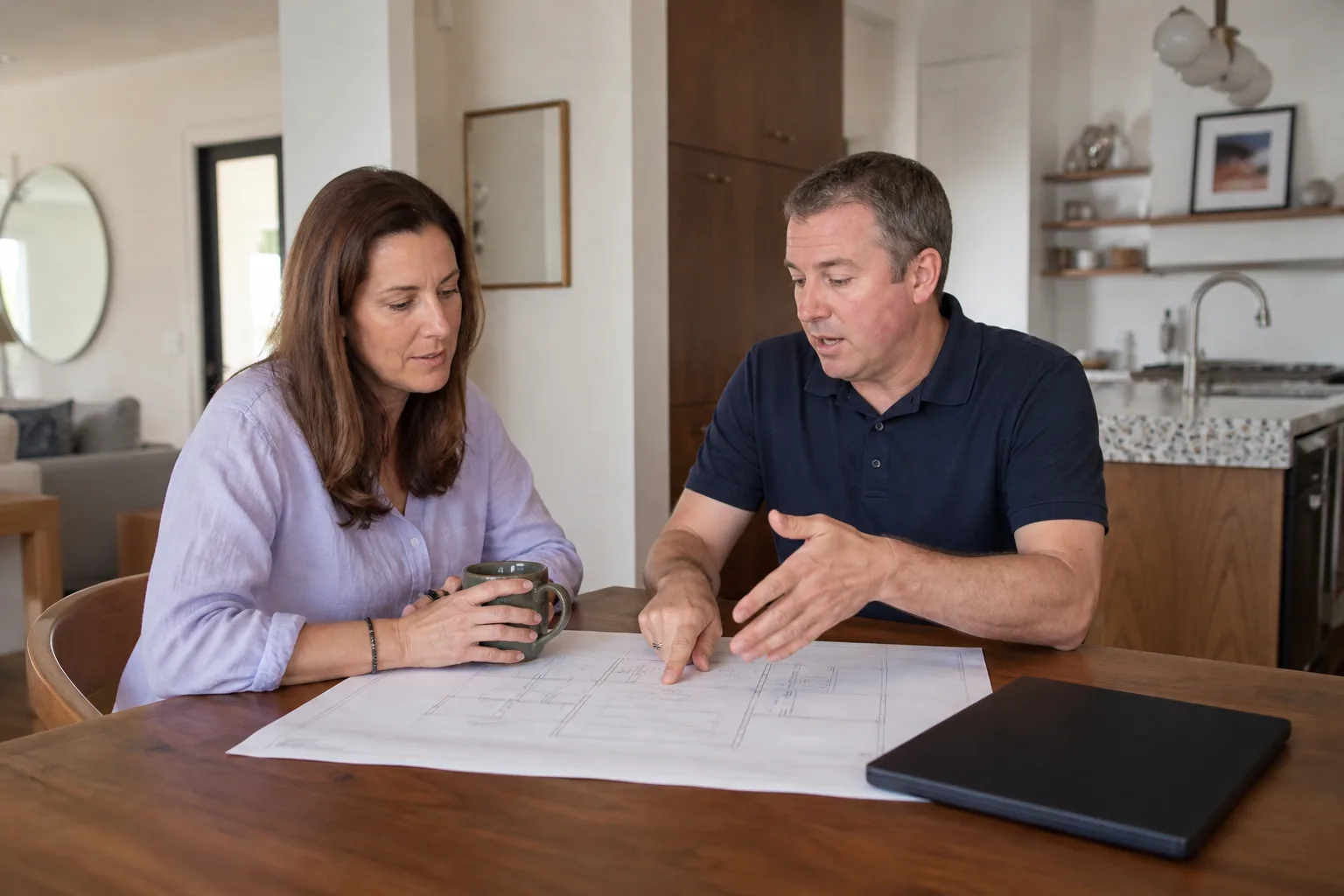
California’s ADU reforms did something real: they stripped away most of the subjective, discretionary power cities once used to block ADUs. Riverside now operates within a framework where a compliant application gets approved, period. What remains is process – completeness reviews, plan checks, correction notices, inspections – and that process rewards preparation. Know what goes in at intake, know the fee thresholds, know the inspection sequence, and respond to corrections with precision. The law gives you the right to build. Doing the paperwork right gives you the permit. And if you want the paperwork handled end to end, with a written price and a 365-Day Done Right Promise on the build itself, Home Addition Contractor in Riverside does that every day. Same team that handles Room Addition Contractor in Riverside work, same written-guarantee standard, same live person on the phone when you call.
Written by Troy Eastman, Owner at Benson ADU Riverside, serving Riverside since 2006.